- 8:1
- FAA-required clear approach slope for a hospital helipad — a 200-ft tower breaks it within 1,600 ft
- 400 ft
- How close a 200-ft tower intrudes on the helipad's side (2:1) protection surface
- STEMI + Stroke
- Temecula Valley Hospital is a designated heart-attack and stroke receiving center
What the FAA's own rules require
A hospital helipad isn't just a painted square — federal rules protect the open air above its approach. Under the FAA's heliport design standard, the approach and departure path must rise at a slope of 8:1: one foot up for every eight feet out. Do the arithmetic and a 200-foot tower breaks through that protected surface anywhere within 1,600 feet of the pad along the flight path. The protection along the sides is steeper still — 2:1 — so a 200-foot tower intrudes on it within just 400 feet. [1]
Anything that pokes through those surfaces is, in the FAA's own words, presumed to be a hazard unless a formal aeronautical study proves otherwise — and the remedies the FAA lists are to remove the object or reduce its height. Separately, any structure taller than 200 feet must be reported to the FAA for an obstruction evaluation, and SDG&E has said these towers may exceed 200 feet. [1] [2]
This matters here because the proposed corridor runs along Temecula Parkway and Temecula Creek — the same street and creek as Temecula Valley Hospital. Towers up to roughly 200 feet beside the hospital are precisely the structures these rules are written to keep out of a helipad's airspace. [3] [4]
How close is too close?
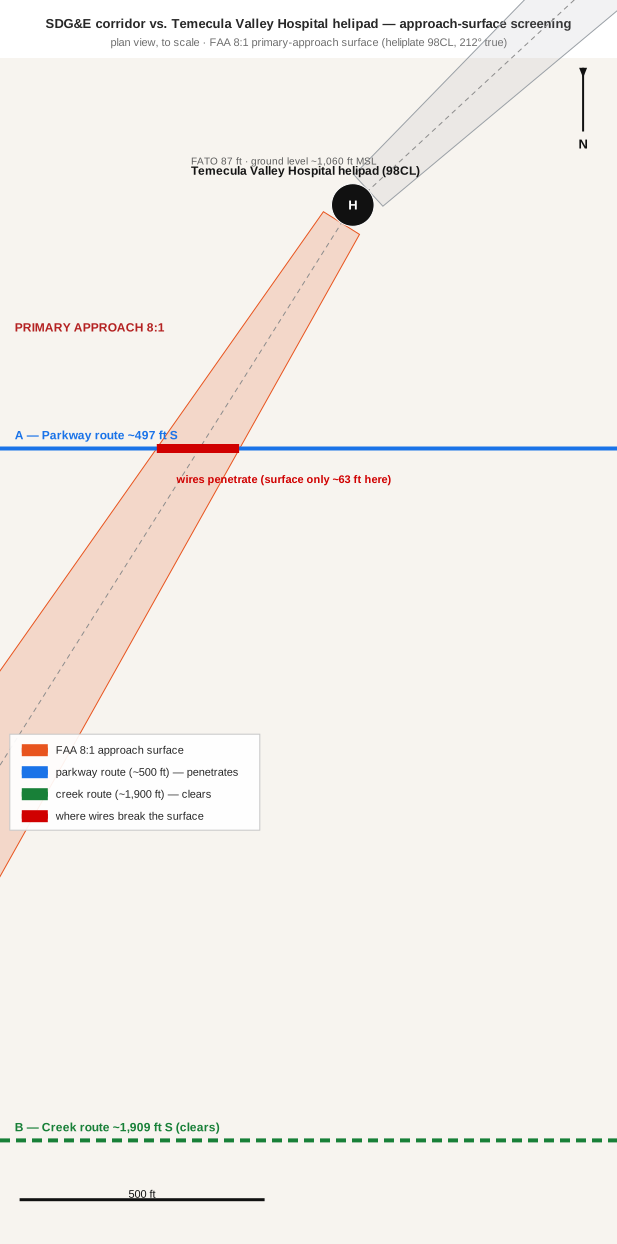
We ran a geometric screening. The hospital helipad's flight path is on public record — its FAA-surveyed primary approach runs to the southwest — so we tested SDG&E's preliminary corridor against the FAA's 8:1 approach surface. The answer turns almost entirely on one thing: how far south of the hospital the line ends up. [1]
If the line follows Temecula Parkway — roughly 500 feet from the pad — then 125-to-200-foot towers and their wires break through the protected approach surface by about 60 to 140 feet, a textbook obstruction. Shift the line out toward Temecula Creek, around 1,900 feet away, and it passes safely beneath. The FAA's own slope gives a simple rule of thumb: a tower needs to stay beyond roughly seven times its height from the pad — about 1,400 feet for a 200-foot tower — to stay clear. [1]
Two honest caveats: SDG&E hasn't published exact tower locations yet, and our distance to the route is measured from public maps, not a survey. That is precisely the point — this is a conflict serious enough that the FAA's obstruction review and the environmental study must resolve it before any approval, and the remedy is simply to route the line far enough from the hospital. [1] [8]
This has happened before
When a tall structure threatens a hospital's helicopter access, regulators act on it. In Seattle, the FAA issued a “notice of presumed hazard” against a proposed high-rise in part because it could interfere with helicopters carrying emergency patients to Harborview Medical Center and force the helipad to close — and the developer had to cut the building's height. [5]
In Boston, Brigham and Women's Hospital had to relocate its helipad to a higher rooftop after a neighboring building project would have intruded on the flight path to its existing pad. [6]
The pattern is consistent: a hospital helipad's protected airspace is taken seriously, and it's the structure in the way that gets moved or lowered — not the hospital that loses its air access.
What's at stake for Temecula
Temecula Valley Hospital is a designated heart-attack (STEMI) and stroke receiving center — the kind of facility where minutes decide outcomes and air transport can be the difference. [3] Power lines are also among the deadliest hazards in flight: the FAA reports that wires are nearly invisible to pilots and account for a large share of fatal helicopter crashes. [7]
California adds another lock. State law requires a permitted hospital heliport to keep a clear 8:1 approach and 2:1 side surfaces; a tower that breaks them means the pad no longer meets the standard, and Caltrans can deny or condition the heliport's permit. [8]
We are not claiming the final towers are placed yet — they aren't, and that is exactly the point. Before any approval, the environmental review must determine whether SDG&E's towers can coexist with Temecula Valley Hospital's helipad and the emergency air access this community relies on. On the FAA's own numbers, a 200-foot tower beside the pad is a serious conflict that has to be answered — not assumed away. [1]
Sources
- [1]FAA Advisory Circular 150/5390-2D, "Heliport Design" — 8:1 approach/departure & 2:1 transitional obstruction surfaces; presumed-hazard rule — U.S. Federal Aviation Administration
- [2]14 CFR Part 77 — Safe, Efficient Use and Preservation of the Navigable Airspace (§77.9 notice criteria; §77.17 obstruction standards) — U.S. Government (eCFR) / Cornell Legal Information Institute
- [3]Temecula Valley Hospital (Universal Health Services / Southwest Healthcare) — facility profile & emergency designations — Southwest Healthcare / UHS (official)
- [4]Temecula City Council presentation (SDG&E 'Preliminary Route: Temecula Segment' slide + route map) — City of Temecula
- [5]FAA "notice of presumed hazard" vs. Seattle "4/C" tower — risk to Harborview Medical Center hospital helipad; building downsized (2016) — KOMO News / Seattle Daily Journal of Commerce / CNN Travel
- [6]Brigham and Women's Hospital helipad relocated because an adjacent building penetrated its flight path (2018) — Brigham Bulletin / Boston Globe
- [7]Power lines/wires as a leading helicopter & air-ambulance hazard — FAA wire-strike data; HAA preflight rule 14 CFR §135.617; obstruction marking AC 70/7460-1 — FAA Safety Briefing / U.S. DOT Volpe National Transportation Systems Center
- [8]21 CCR §§3525–3560 (Caltrans Division of Aeronautics heliport permits) & CA Public Utilities Code §21001 et seq. (State Aeronautics Act) — California Department of Transportation, Division of Aeronautics